
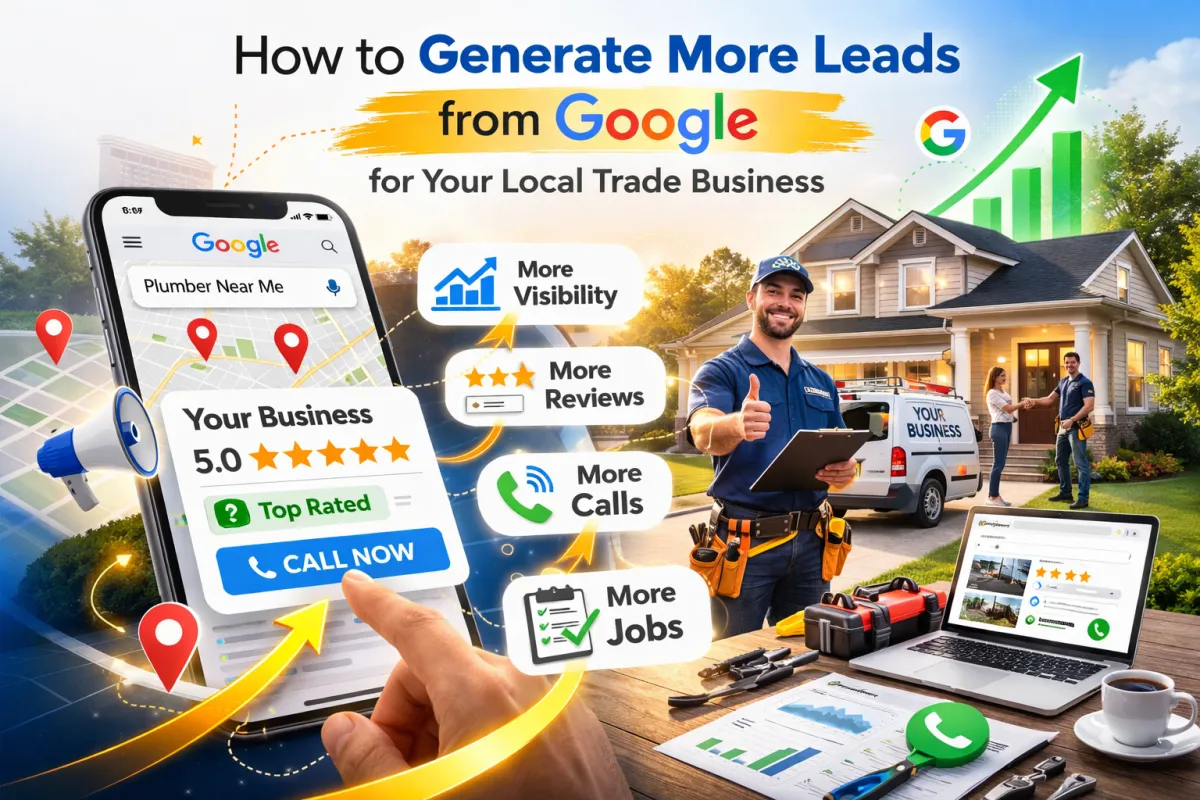
How to Get More Leads from Google for Your Local Trade Business
Introduction
Local trades like electricians, plumbers, roofers and landscapers rely on a steady flow of phone calls and emails to stay busy. In 2026 the path to those calls starts on Google. Statistics show that around 46 % of all Google searches have local intent and 97 billion local searches are conducted each month. Even more important, 78 % of mobile local searches lead to an offline purchase and 88 % of people who perform a local search on their smartphone visit or call a business within a week. These numbers show that people looking for a trade on Google often become customers quickly. This guide explains how to tap into those searches and convert them into leads.
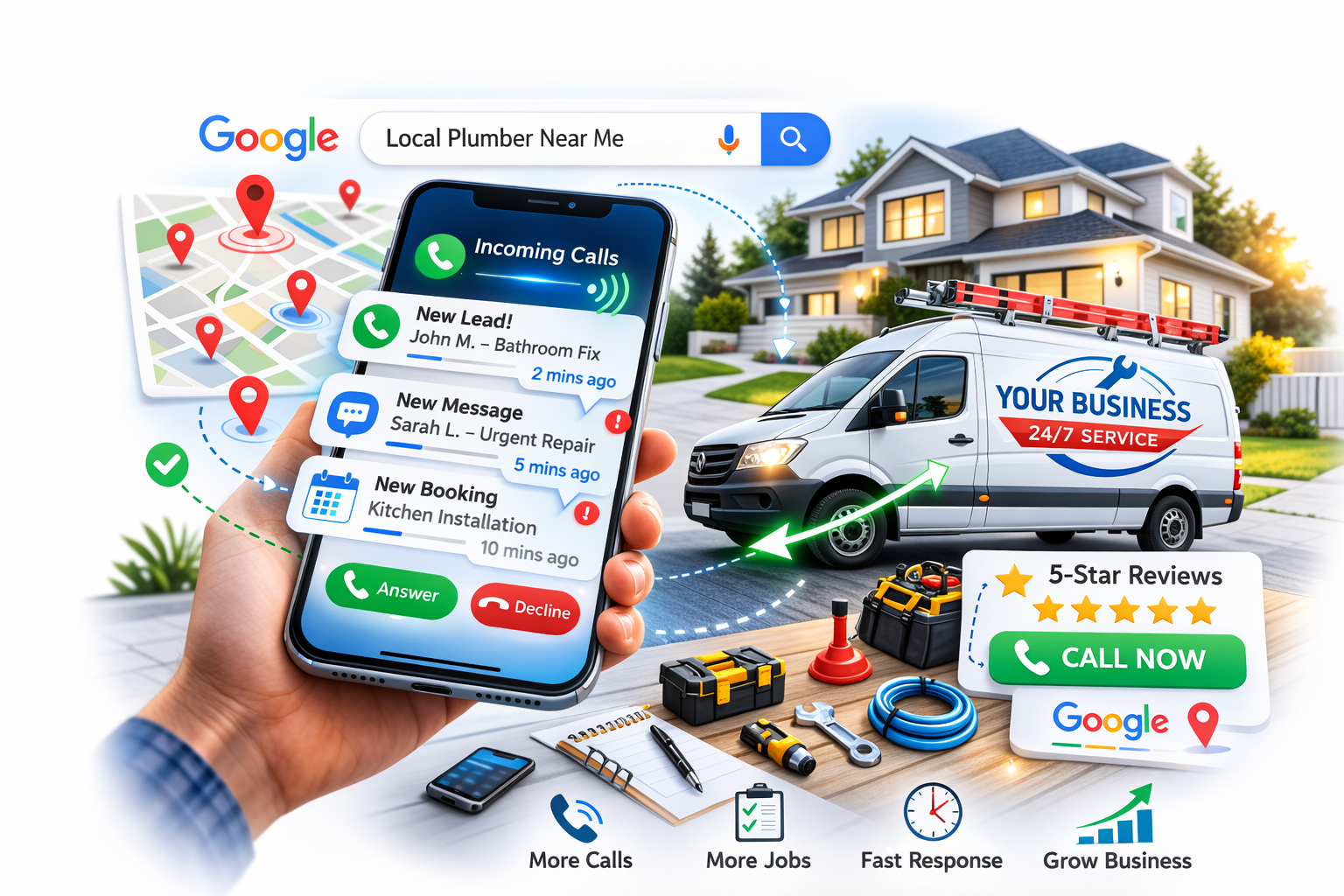
Why Local Search Matters to Trades
Local searches are high intent
Unlike general browsing, local searches often indicate an immediate need. Someone searching for “electrician near me” or “burst pipe repair” isn’t just learning; they want help now. Data from Coalition Technologies notes that 46 % of product searches begin on Google and 46 % of monthly Google searches have local intent. The 3.2 billion daily local searches represent real opportunities for tradespeople to capture new work.
Mobile behaviour drives calls
Mobile devices dominate local search. According to Google statistics, 63 % of organic search traffic in the U.S. originates from mobile devices. On phones, users frequently call businesses directly from search results. Coalition Technologies’ research shows that 78 % of local mobile searches lead to offline purchases, proving that mobile searchers tend to act quickly. For trades, showing up with a phone number or call button can convert those moments into jobs.
Visits and calls follow quickly
Searches for local services often result in immediate action. ThinkwithGoogle research (cited by Coalition Technologies) reports that 88 % of people who conduct a local search on their smartphone visit or call a store within a week. If your business isn’t visible or lacks essential information, those customers may go to a competitor.
Optimise Your Google Business Profile (GBP)
Claim and verify your listing
Your Google Business Profile appears in map results and on mobile when people search for your trade. Claiming and verifying the profile ensures you control the information shown and can respond to reviews. MJI Marketing recommends starting with “simple signals that show you are nearby, open and easy to reach”. Verification allows you to select precise categories (e.g., “plumber”, “electrician”) and add business hours, photos and contact details.
Keep name, address and phone consistent (NAP)
NAP consistency signals trust to Google and customers. MJI Marketing suggests keeping your name, address and phone number the same on your site and across trusted directories. Discrepancies confuse search algorithms and potential clients, reducing your visibility.
Add services, products and photos
Including services and products with short descriptions helps Google understand what you offer and improves your visibility. MJI Marketing notes that adding products/services with a price range can help people decide. Posting one fresh photo or update each week from real jobs builds trust and signals activity. Upload images of completed work, vehicles with signage or team members on a job to give people visual reassurance.
Encourage and respond to reviews
Reviews influence local ranking and consumer trust. Encourage customers to leave feedback after each job; even a few new reviews every month carry more weight than a flood once a year. Respond promptly with genuine comments referencing the service or neighbourhood so your replies feel personal. BrightLocal research cited by Envision Creative reveals that 88 % of consumers use a business that responds to all reviews compared to only 47 % who use businesses that don’t. Acting on reviews shows you care and enhances your ranking.
Target the Right Keywords
Understand intent
Start with terms that actual customers use, not technical jargon. MJI Marketing advises creating pages that use phrases people actually say such as “water heater repair in Roanoke”. Ask your clients what they type into Google when searching for your services. Focus on high-intent phrases like “emergency plumber near me,” “same-day electrician,” or “roof repair quote.” These queries show readiness to hire.
Use geographic modifiers
Include city or neighbourhood names in your keywords. For example, “landscaper in Huntingdon” or “HVAC repair Cambridge.” Service and city pages help Google match your business to local searches. Build a page for each key service and each location you serve; lead with a simple summary, include FAQs mirroring real calls and end with a clear next step.
Add long-tail and question keywords
Longer phrases or questions attract customers looking for specific solutions. Include how-to questions and common issues like “why does my boiler keep turning off?” or “how much does a roof leak repair cost?” Provide concise answers; short, clear responses help your content show up in AI-powered search results.
Invest in Local Service Ads (LSAs)
Google Local Service Ads (LSAs) appear above paid search ads, map packs and organic results. They show your rating, certification badge and a direct call button. LSAs operate on a pay-per-lead model: you pay only when someone contacts you via the ad. This makes LSAs more predictable than pay-per-click campaigns because you pay for actual leads, not just clicks.
Benefits for trades
LSAs deliver measurable results. According to Google’s data, businesses that appear in LSA results get 25–30 % more calls than those relying solely on organic listings. Adoption has surged from roughly 28 % of contractors using LSAs in 2022 to an estimated 70 % by late 2025. The ads display a “Google Screened” or “Google Guaranteed” badge that signals trust. For emergency searches like “pipe burst” or “power outage,” LSAs cut the website out of the equation, letting customers call you instantly.
Differences from standard Google Ads
Traditional Google Ads are pay-per-click: you bid on keywords and pay when someone clicks your ad and visits your landing page. LSAs appear above these ads and use pay-per-lead pricing; there is no website click in the standard format. Many contractors run LSAs for emergency or high-intent searches and Google Ads for planned purchases (e.g., replacement installations).
Setting up LSAs
First, check if your trade qualifies. As of 2026, eligible categories include HVAC, plumbing, electrical, roofing, general contracting, pest control, lawn care, landscaping, painting and garage door services. Prepare documentation such as licenses and insurance, then create your ad profile with photos, service areas and budgets. Once approved, monitor your cost per lead and adjust your bid to stay competitive.
Optimise Your Website for Conversions
Make it fast and mobile-friendly
Customers won’t wait for a slow site. Envision Creative notes that 53 % of mobile visits are abandoned if a page takes more than three seconds to load. Compress images, use caching and choose a reliable hosting provider. Ensure your site adapts to different screen sizes and emphasises click‑to‑call buttons on mobile.
Create clear service and location pages
Dedicate a page to each service (e.g., emergency plumbing, rewiring) and each city or town you serve. Use headings and simple summaries at the top, include frequently asked questions and provide one clear call‑to‑action, such as a phone number or form. Use schema markup to help search engines understand your content and improve your chance of appearing in rich results.
Use compelling calls-to-action
Guide visitors toward contacting you. Place phone numbers prominently at the top of each page, add contact forms, live chat or messaging options. Use action-oriented words like “Call now,” “Get a free quote” or “Schedule service today.” Include trust badges, guarantees and short testimonials to increase confidence.
Show proof and trust signals
People are more likely to hire you if they see evidence of quality work. Add before-and-after photos, case snapshots or brief timelines on your pages. Include badges such as Google Guaranteed, certifications or association memberships. Highlight your star rating and link to your Google reviews.
Respond Quickly to Leads
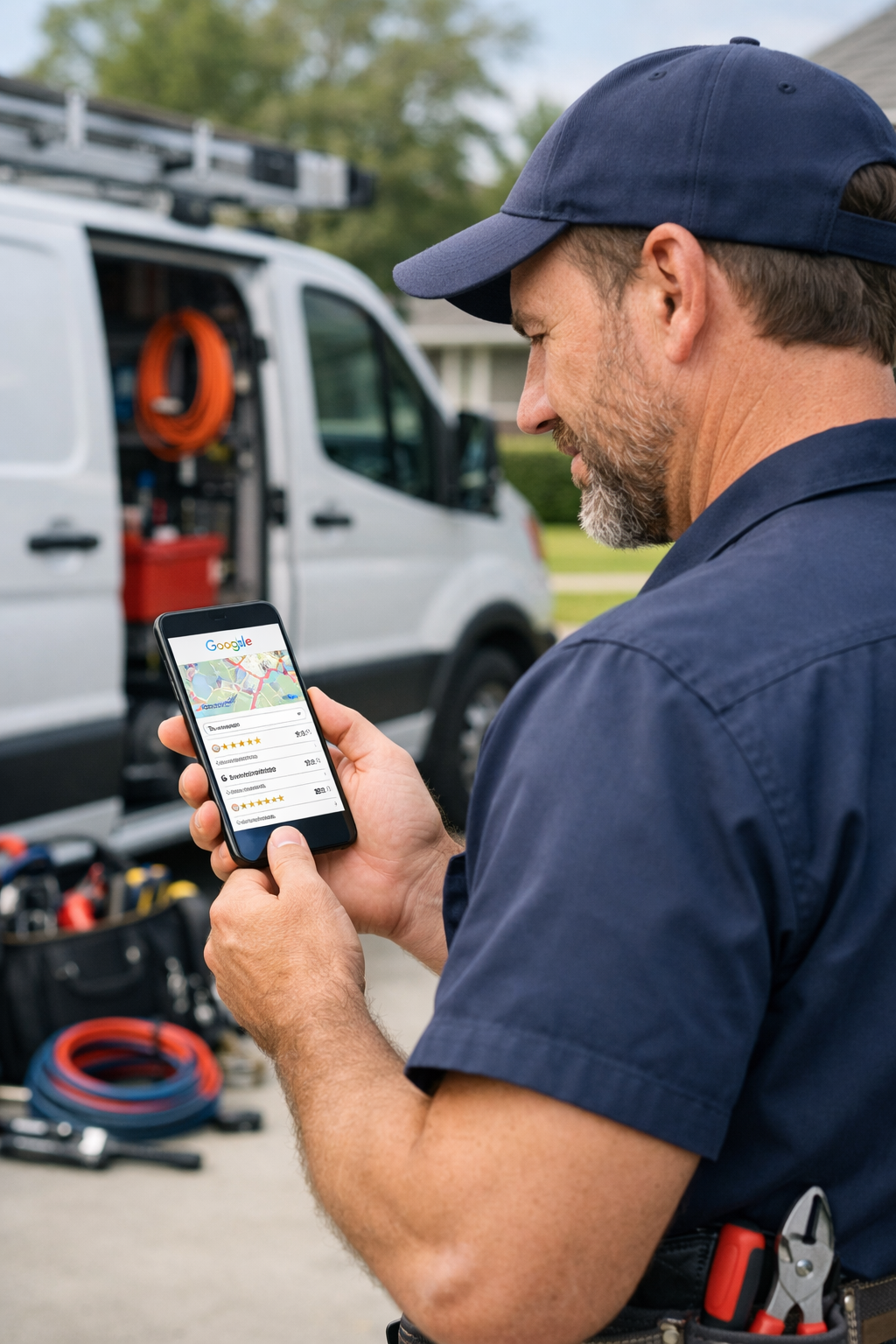
Speed matters as much as ranking. An Optifai study of 939 companies found that leads contacted within five minutes are 21× more likely to qualify and achieve a 32 % close rate. The advantage drops steeply: 80 % of the close-rate advantage disappears within the first 30 minutes. Only 23 % of companies respond within five minutes, so meeting this benchmark gives you an edge. Create processes to respond quickly:
Use call tracking and form alerts to notify you instantly.
Set up auto‑response emails or SMS that confirm receipt and offer immediate booking.
Assign an on‑call rotation so someone is available to answer inquiries.
Use round‑robin or territory-based routing to assign leads promptly.
By catching leads within their peak intent window, you’re more likely to schedule the job before they contact a competitor.
Blend Organic and Paid Strategies
Local SEO isn’t just about ranking; it’s about capturing attention across the page. Sterling Sky warns that AI-powered local packs and fewer call buttons mean that even well-ranked businesses see fewer calls. Meanwhile, LSAs put your listing above the map pack, and Google Ads still capture clicks for planned purchases. Combining organic optimisation, LSAs and paid ads ensures you show up in multiple places.
Monitor, Measure and Adapt
Track calls, form submissions and bookings to understand what works. Use call tracking numbers to attribute leads to specific pages or campaigns. Monitor metrics such as actions per view (calls, website clicks, requests for directions) to gauge performance. If one service page drives more calls, prioritise that service in ads and content. As local SEO trends evolve—like AI local packs featuring fewer businesses—be ready to adjust your strategy.
Conclusion
Getting more leads from Google in 2026 requires a holistic approach: claim and optimise your Google Business Profile, target the phrases your customers use, invest in LSAs for high-intent searches, make your website fast and compelling, respond promptly to inquiries and diversify across organic and paid channels. By following these steps and staying current with local search trends, tradespeople can turn Google’s billions of local searches into real jobs and steady revenue.
The steps above aren't complicated, but they do take time and ongoing attention. Most trades businesses don't have either in abundance.
If you'd rather hand this off to people who do it every day,Studio Sable's Local SEO packagescover everything in this guide and more — GBP optimisation, citation building, review systems, and a guaranteed top-3 ranking within 90 days.
Book a free local SEO auditand find out exactly where you stand.


